Armored window film: Prozorro’s number of customers has quadrupled
Back in 2024, only a few dozen budget institutions across the country purchased protective film for windows. Now it is included in the budgets of communities, regional administrations, hospitals, and schools. The reason is simple: during attacks, a significant portion of injuries in buildings are caused not by the explosions themselves, but by sharp fragments of glass. The Kiev company Glass Shield (a division of PapaPrint, which has been working with glass films since 2014) analyzed purchases at Prozorro and tells how demand has changed and what those who plan to armored film for windows should know.
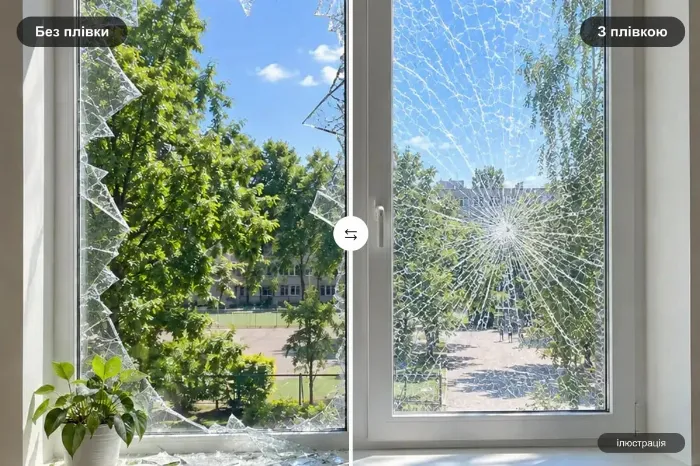
Customers have quadrupled
According to Glass Shield’s calculations based on Prozorro data, in 2024, 39 state and municipal customers, in 2025 - 78, and in the first nine months of 2026 - at least 151. Among them are regional and city administrations, village and settlement military administrations, hospitals, colleges, energy enterprises and communal services.
The largest number of purchases is in Zaporizhia region, followed by Kyiv, Sumy, Dnipropetrovsk and Kharkiv regions, i.e. regions that most often suffer from shelling.
Zaporizhzhya made it a program
In June 2026, the Zaporizhia regional military administration decided to protect the glass of hospitals, schools, administrative buildings, unbreakable points and public transport with film. In Zaporizhia educational institutions alone - over 6,000 windows. The film is also purchased by the communities of the region, in particular the military administrations of front-line villages and towns.
In other regions, budgets for 2027 are currently being formed, and for hospitals, schools, and administrative buildings this is a window of opportunity: glass protection can be included in a separate line, rather than looking for money after another strike.
What the film does and does not do
A protective film is a transparent multilayer polyester with a strong adhesive that is glued to the inside of the glass. The glass still cracks from an impact or blast wave, but the fragments remain on the film and do not fly into the room. A window with the film does not become bulletproof, and the film itself does not replace shelter. Its task is to contain fragments and reduce the risk of injuries from them.
Therefore, the first places to protect are places with a lot of people and a lot of glass: classrooms and school corridors, hospital wards and reception rooms, ASCs, waiting rooms, shop and pharmacy windows, as well as paths to shelters.
How not to make a mistake with the thickness
- 200 microns - windows of classrooms, wards, offices, offices and apartments. The most common choice.
- 300 microns - first floors, shop windows and procurement, where the customer requires a thickness of 300 microns or more.
- 400 microns - large shop windows, entrances and facade glass, where maximum protection is required.
Thin films of 100 microns do not protect against a blast wave, so Glass Shield does not offer them. The second common mistake is the film glued to poorly washed glass: dust and bubbles eventually peel it off, and at the right moment it does not hold the fragments.
How to buy it
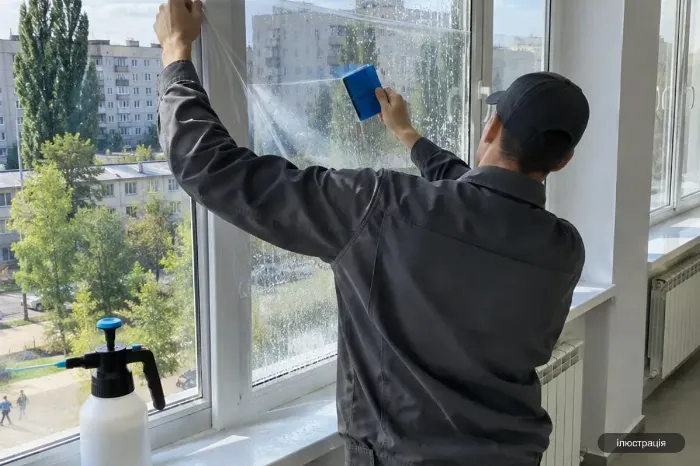
For budget institutions, Glass Shield prepares commercial offers to justify the cost and technical requirements for the film for Prozorro. The teams are based in Kyiv and Dnipro and travel throughout Ukraine: measuring, cutting on their own plotters, installation in the evenings or on weekends so as not to interrupt the work of the school or hospital, certificates and a photo report for each room.
Turnkey pasting together with the material costs from 1,425 UAH per m² of glass for a 200 μm film and from 1,810 UAH for 300 μm, objects from 1,000 m² are calculated individually. For apartments and private houses, there are kits for self-pasting: the film is cut to the size of the windows and tools and video instructions are included, a kit for 5 m² - from 3,810 UAH.
To get a preliminary calculation, it is enough to send a photo of the windows and the approximate area of the glass. More information about thicknesses, prices and typical solutions for schools, hospitals and administrative buildings can be found on the website Glass Shield.
Glass Shield is a brand of Papa Print LLC. Hotline: 0 800 332 175 (toll-free within Ukraine). Email: shield@papaprint.com.ua. Address: Kyiv, Vasyl Yana St., 3/5.


How to build a multi-level security system for a private home